
Less paperwork, better insight into patients’ recovery: highlights from the European Stroke Quality Transformation Summit
On 7 October, more than 80 clinicians, researchers, policymakers and representatives of the World Health Organization, the World Stroke Organization and patient organisations from 24 countries gathered in Prague for the European Stroke Quality Transformation Summit. The event marked the conclusion of RES-Q+ and focused on three questions: how to reduce the administrative burden on clinicians, how to use artificial intelligence safely, and how to find out how patients are doing after they leave hospital.
Why it matters now
According to the Stroke Alliance for Europe (SAFE), around 1.1 million strokes occur in Europe every year, and almost 10 million people are living with the consequences. The Summit took place only months after the World Health Assembly adopted its first-ever resolution dedicated to stroke (WHA79.10), which calls for stronger national stroke registries, quality monitoring and interoperable digital health solutions – the very areas RES-Q+ has been working on.
“Data collection is not the final objective. The purpose of quality monitoring is to improve outcomes for people affected by stroke. AI in health requires clear governance, appropriate regulation, data protection, transparency and meaningful human oversight. It must be safe, trustworthy and designed to reduce – not widen – inequalities,” said Zsófia Pusztai, Head of the WHO Country Office in Czechia, in her opening address.

From a registry to a global platform
RES-Q+ builds on RES-Q, a global platform for monitoring and improving the quality of stroke care, developed and operated by the Brno-based Health Management Institute. Today, RES-Q is used by almost 3,000 hospitals in 98 countries. In September 2026, it passed 1.5 million recorded patient cases, with around 1,000 new cases added every day.
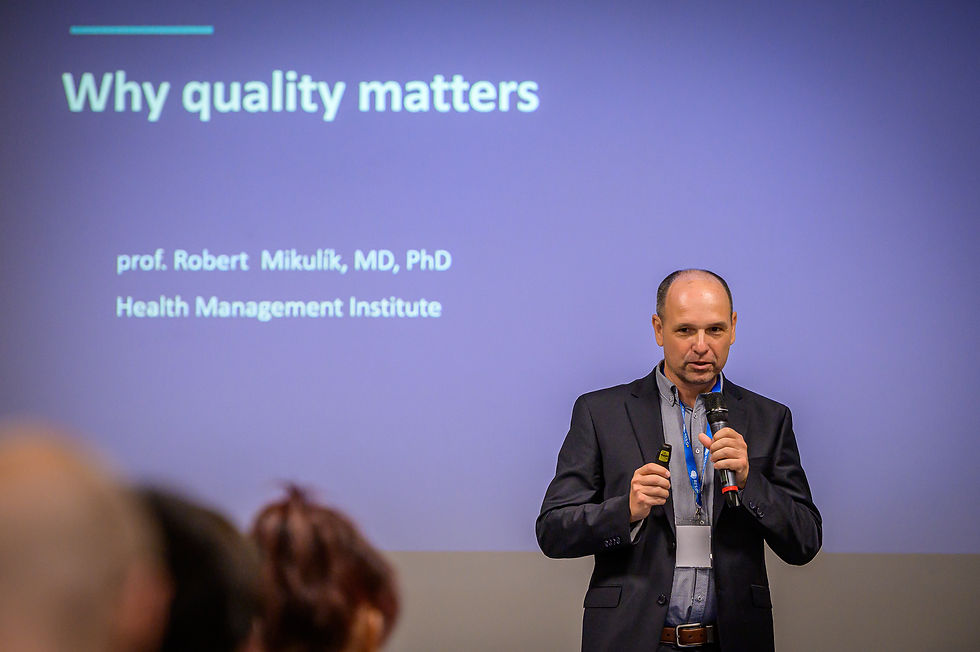
“When we started RES-Q together with the European Stroke Organisation, we wanted every hospital in Europe to know how well it treats its patients, where the gaps are and what it can improve. The next step is to follow patients for months after discharge, because only that shows the real outcome of treatment,” said Prof. Robert Mikulík, neurologist and founder of RES-Q at the Health Management Institute.
From hospital to home: RES-Q+ tools in action
Participants saw live demonstrations of three tools developed in RES-Q+:
Discharge Importer Tool (DIT) uses AI to read key information from discharge reports and transfer it automatically to the RES-Q platform, so clinicians no longer have to retype treatment and hospitalisation data by hand.
Clinician Assistant is an AI-based virtual assistant that helps clinicians analyse quality-of-care and patient data, saving time and supporting decisions on further treatment and improvement.
Sana, the patient virtual assistant, stays in touch with patients after they return home. It helps them record key health data such as blood pressure, glucose, LDL cholesterol or BMI, and uses short questionnaires to track their mood, mental health and ability to manage everyday activities, giving clinicians a clearer picture of each patient’s recovery.
Learning from each other
Following the Stroke Quality Journey – MEASURE, AUTOMATE, UNDERSTAND, FOLLOW, TRUST and IMPLEMENT – the summit brought together participants from 24 countries. Speakers from Lithuania, Moldova, Poland, Romania, Denmark, Ireland and the United Kingdom, among others, shared their national experience. Sessions also covered the conditions for using AI safely in healthcare, including the EU AI Act, the Medical Device Regulation and the European Health Data Space. In the closing session, representatives of the WHO Regional Office for Europe, the World Stroke Organization and the ANGELS Initiative shared their perspectives on the next steps. The host country - Czechia - offered a concrete example of what quality data can achieve.
“In the Czech Republic, we have managed acute stroke care very well. We have the shortest times to the start of thrombolysis and among the shortest times to mechanical recanalisation in the world. We also manage our network of stroke centres through quality: we regularly tell each centre how well it treats its patients and give it the chance to improve. Our biggest gap remains long-term follow-up after stroke, especially secondary prevention. That is why we are preparing mandatory monitoring of patients’ condition three months after stroke and the establishment of outpatient cerebrovascular clinics for stroke survivors outside hospitals,” said Aleš Tomek, Chair of the Czech Stroke Society and European Stroke Organisation representative for the Stroke Action Plan for Europe.
Thank you
RES-Q+ has shown how data, automation and artificial intelligence can be used not only to monitor the quality of hospital care, but also to better understand how patients are doing after discharge. We would like to thank all speakers, participants and partners who made the Summit possible, and the Czech Minister of Health and the World Health Organization for granting their auspices. The Summit was organised by the Health Management Institute, the Institute of Health Information and Statistics of the Czech Republic, Charles University, the ANGELS Initiative and the RES-Q+ consortium. RES-Q+ is funded by the European Union.




Comments